
Converting an internal combustion vehicle to electric is an interesting project, but it can be daunting without a clear plan. That’s where our EV conversion method, SPARK, comes in. This method allows for anyone to design and plan an EV conversion methodically. Once you’ve defined your vehicle’s operational goals in the Select Phase of SPARK, the next step is to ensure that it will meet those expectations. How? By creating the Energy Blueprint.
The Energy Blueprint tells you how much energy and power your EV needs to meet the expectations set in your Engineering Decisions from the Select Phase of SPARK.
What is the Energy Blueprint
The Energy Blueprint is the cornerstone of the Plan Phase. It represents the total Energy and Power required to meet your vehicle’s expectations. By carefully analyzing your Engineering Decisions and applying First Principles you’ll be able to come up with the following:
- Force estimations for moving the vehicle at different speeds, inclines and acceleration levels
- Power demands under worst-case scenarios, such as maximum acceleration, steep inclines or a fully loaded vehicle.
- Energy estimations for meeting range and performance goals.
What these estimates and calculations allow you to do is properly choose the components that will power your EV, like motor and battery in the next phase of SPARK: Architect.
First, you need to understand the forces acting on the vehicle as defined by your Engineering Decisions. In essence, there is a traction force pushing the vehicle forward, and a total resistance force opposing its motion.
- If the traction force is greater than the total resistance force, the vehicle will increase speed, or accelerate.
- If the traction force is less than the total resistance force, the vehicle will decrease speed, or decelerate.
- If traction and resistance forces are equal in magnitude, vehicle speed is maintained.
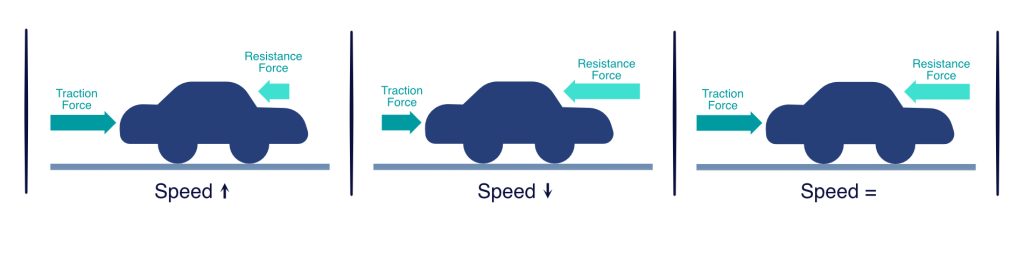
Power is directly related to force. The more force produced at a given speed, the more power is produced. More power equals more speed, more acceleration, and steeper inclines that the vehicle will be able to climb.
Energy, in the simplest terms, is how long a certain amount of power can be maintained – think of it as the ‘gas in the tank’ for a traditional combustion car, but in this case, it’s stored as electricity in the battery. The more power the motor generates, the less time the energy in the battery will last.
How to develop your Energy Blueprint
1. Define Operational Scenarios
Revisit your Engineering Decisions from the Select Phase.
Identify:
- Type of Vehicle
- Total weight of the vehicle (GVW – Gross Vehicle Weight)
- Maximum Grade
- Maximum Speed
- Maximum Acceleration
- Desired Range
- Weather Conditions
2. Calculate Resistance Forces
To estimate the energy and power required for your EV conversion, The Total Resistance Force is the sum of the following forces:
- Aerodynamic Drag Force. This force resists the vehicle’s motion as it moves through the air. The denser the air, or the bigger and more complex the frontal area of your vehicle, or the faster it’s going, the harder it is to ‘cut through the air’. Imagine a semi-truck versus an arrow, which one ‘cuts through the air’ the easiest?
- Rolling Resistance Force. This force results from the friction between the tires and the road. The material of the road and tires affects this.
- Grade Resistance Force. This is the force required to move the vehicle up an incline or hill. The heavier the vehicle and the steeper the incline, the harder it is to push it uphill.
In order to accelerate the vehicle, the traction force needs to be greater than the resistance forces, but how much greater? In order to calculate this, you also need to estimate the force required to accelerate the mass of the vehicle:
- Acceleration Force. The force needed to increase the vehicle’s speed. Think of throwing a baseball: the harder you throw it, the faster it will move.
The total force the motor must produce is the sum of all these forces at any given time.
3. Calculate peak power
Peak power is the absolute maximum power we will require from the motor in order to fulfil our vehicle’s needs, even in its worst use cases.
It is now time to think of the following scenarios from your Engineering Decisions. These scenarios represent some of the worst cases that your vehicle will have to go through.
- Maximum Speed – What is the power required at maximum speed, with 1 passenger and no extra payload on a flat road?
- Maximum Acceleration – What is the power required to accelerate the vehicle from 0 to 60 MPH in your desired time, with one passenger and no extra payload on a flat road?
- Maximum Payload and Maximum Grade (cruising speed) – With a fully loaded vehicle (passengers and payload/trailer), what’s the power required to maintain 60 MPH on the steepest incline in your area?
- Maximum Payload and Maximum Grade (accelerating) – With a fully loaded vehicle, what’s the power required to accelerate from 0 to 30MPH in 12 seconds at a 7% grade?
The maximum power needed by your conversion is the highest of these values.
As you can see, if you do a good job with your Engineering Decisions, you will be able to properly define your Energy Blueprint. If you overestimate, your EV conversion will require more power, which translates into more expensive components. Why pay extra for something you will never need? Choose wisely!
What about system efficiencies?
The estimations above are for power at the wheels, but the power needed to feed the motor is higher due to efficiencies.
What is efficiency? Efficiency is, in simple terms, the percentage of energy from the battery to the motor that is converted into movement of the wheels.
Have you ever noticed that any electric motor, like a vacuum cleaner’s, gets hot when it’s running? This heat is energy from the battery that did not convert into motion. The more efficient the motor is, the less heat and vibration it produces.
What does this all mean for our estimations? Simple. This means that the power required from the motor needs to be higher than the power at the wheels due to the cost of converting energy. This comes from the Second Law of Thermodynamics, which, in essence, tells us that no energy conversion is 100% efficient.
A quick example to illustrate this: considering typical motor efficiencies of 90%, that means that the wheels are getting only 90% of the energy put into the motor. If the estimations for peak power come out to be 90kW at the wheels, it means that in order to meet this power requirement, the battery needs to provide the motor with 100kW of power. Converting energy is not free!
4. Estimate Energy for Range
If you recall from the explanation earlier, energy is how much time we can maintain a certain level of power. You already know how peak power is estimated, but your EV conversion might not be expected to run at peak power all the time. The question, then, is: how much power is your conversion expected to use on a day to day basis? If you want the range of your conversion to be, say, 100 miles, how much energy do you need in your battery? It depends on the average power you will use!
Automakers normally calculate energy required by analyzing complex speed and acceleration profiles derived from standardized drive cycles. These detailed calculations allow manufacturers to estimate energy use for specific driving conditions with precision. However, this level of complexity isn’t always practical for DIY EV conversions.
A rule-of-thumb approach offers a quick and much more simple way to estimate energy requirements and determine the size of the battery pack. The way this method works is very simple: based on existing data from similar vehicles, the energy consumed per mile driven can be estimated. Yes, the number you come up with might be slightly different than reality, but the error will not be high enough as to be a problem. This calculation gives us an idea of approximately how many batteries you need (battery cells or battery modules – we’ll talk more about the specifics in future articles).
Energy Consumption per Mile by Vehicle Type
The following table shows the category of vehicle, an estimate of its energy consumption per mile, and vehicle examples for each category.
| Vehicle Type | Examples | Consumption (Wh/mile) |
| Small Hatchbacks | Ford Fiesta, Honda Fit, Volkswagen Golf | 200–250 |
| Small Convertibles | Mazda Miata, BMW Z3, Fiat 124 Spider | 220–280 |
| Sports Cars | Ford Mustang, Chevy Camaro, Mazda RX-7 | 300–350 |
| Large Family Sedans | Chrysler 300, Toyota Avalon, Honda Accord | 350–400 |
| Off-Road Vehicles | Jeep Wrangler, Toyota FJ Cruiser, Ford Bronco | 400–500 |
| Small SUVs | Toyota RAV4, Honda CR-V, Ford Escape | 300–400 |
| Large SUVs | Chevy Suburban, Cadillac Escalade, GMC Yukon | 450–600 |
Now let’s start with the estimation of the energy required from your battery.
- Select the Consumption Value. Determine your vehicle’s approximate energy consumption from the table above.
- Multiply Consumption by Desired Range. If your selected vehicle consumes approximately 200 Wh/mile, and your desired range is 100 miles, you need 20000 Wh, or 20kWh, of energy in your battery.
- Add a Safety Margin. Include a buffer of 10–30% to account for inefficiencies, battery aging, weather and real-world conditions.The more risk averse you are, the higher the buffer. Sounds trivial but this is where part of the creative aspect comes from: making decisions.
Why This Method Works for EV Conversions
Considering that EV conversions are a form of art and expression, more so than a practical engineering practice, it makes sense why doing as little detailed calculations as possible makes more sense. You want to pay attention to the details that matter, and coming up with very detailed calculations might make things harder to tackle and therefore less enjoyable. Think of the Pareto Principle: 80% of the results come from 20% of the effort. This method covers 80% of your results.
Key Considerations
- Balance Goals and Costs: Avoid overengineering; size components realistically to meet performance goals. Remember that the more power and range, the more expensive your components, so keep it real!
- Plan for Real-World Conditions: Plan for scenarios you normally encounter. This all comes from proper analysis of what you’ll use your vehicle for: is this your daily driver that must do everything, or is this your cars and coffee ride for Saturdays during the summer?
- Push the boundaries (if you can): if your budget, technical expertise, patience and motivation allow, please, come up with something unique. Make a burnout machine out of that old chevy truck, squeeze 300 miles of range from that 90s Cadillac or make the quickest ice cream truck anyone has seen. Though we love all cars, builds, and overall projects, coming up with new things and sharing them with the community keeps the motivation and passion going for the rest of us.
Final Thoughts
The Energy Blueprint transforms your Engineering Decisions into precise calculations, ensuring your EV conversion achieves its performance goals. With power and energy requirements defined, you’re ready to proceed to the Architect Phase, where you’ll select the components to bring your vision to life.
We’ve gotten from your previously defined Engineering Decisions all the way down to your Energy Blueprint, which will guide you in selecting the appropriate components for your build. By properly assessing the needs of your vehicle you’ll be better suited to find parts that make your vehicle’s vision into a reality. Most of the time it all comes down to cost, though, so make sure you really understand what you want your conversion to do instead of trying to go for everything all at once. Unless you have unlimited budget, in which case please go for it and share your build with the community!
The next articles will dive into the Architect phase, where you’ll explore the challenges and decisions involved in selecting components for your EV conversion. From choosing the right motor to sizing the battery and auxiliary systems, you’ll build your Component Strategy step-by-step, ensuring your vehicle is ready to hit the road with confidence.
Join the conversation: share your thoughts, ask questions, or tell us about your EV conversion journey or plans in the comments below. We’d love to answer any questions we can and/or learn from your experience.

Press clutch to shift gears – a story
Cold air, clear skies and sunlight. My morning workout about to start, taste of cherry…
End of Line – A story
Ah, the beauty of an assembly plant. Cars roll out by the minute, synchronized with…
PLAN – Designing an EV conversion from scratch: a SPARK walk through
Now that we’ve defined what we want this conversion to accomplish, we can start working…

Cold Trips – a story
Boring. Dark. Cold. The industrial warehouse where we sat was furnished to resemble a corporate…

Select – A SPARK walkthrough :Designing an EV conversion from scratch
Ah, EVs. Magical to some, blasphemous to others. Few topics divide the automotive world quite…

Stalls – a story
It was a chilly Pennsylvania morning. Jamie was late to work again; he forgot to…
Also what in that case it is necessary to do?
——
https://the.hosting/ga/help/ustanavlivaem-docker-compose-v-ubuntu
I apologise, I can help nothing, but it is assured, that to you will help to find the correct decision.
——
https://the.hosting/fr/help/kak-smenit-port-ssh
Hi! I’m sorry but I did not understand your question, can you please rephrase so that I can better help you?
Thanks!