
Cold air, clear skies and sunlight. My morning workout about to start, taste of cherry pre-workout fresh in my mouth. A pleasant sense of motivation, probably aided by 200mg of caffeine, took over me. Loud music in my earbuds helped my mind through the workout.
Off to work.
My office was as beige as it ever was, the 90s aura was not everyone’s favorite, particularly on such a sunny day, but I liked it.
Paperwork was the name of the game that week. A few functional improvements for the shift quality of our 9-speed transmission for the Jeep Compass had been developed and their validation was almost done. A software or calibration change that makes it to a production plant has to go through a long list of tests, checks and approvals.
An engineering Change Document (CN) is what FCA used to call these approval documents, and it was my responsibility to carry it through the required steps.
Dull, is what many engineers would call the task of creating, managing and finalizing a CN. Honestly, I liked it. First, it is a very straightforward and sequential process: you document the change, take it to a meeting with managers and executives to kick off the work – initial approval – and work on documenting the validation efforts as they happen. Different people approve the document once all validation has been completed, and the software is then good to go to the plant. Boring sometimes, but very satisfactory.
My workload had been very high during the winter, but it was now more manageable, so when the email came in, I was happy to offer my help.
Miguel,
Marco is coming from Italy to check on a 2018 MP 1.4L that keeps setting a P0805 on the ECM. The vehicle is a Roush fleet asset, it’s in the Auburn Hills Roush facility. Vehicle Scan Report is attached. Have you seen this issue before? Any help is greatly appreciated.
“What the hell is a P0805?” I thought and immediately logged on to our service website to investigate. I knew it was a DTC (Diagnostic Trouble Code), but I had no idea what it was supposed to mean.
“Clutch position sensor A Circuit Malfunction” was the description, which made sense since the Vehicle Scan Report showed the vehicle had a manual transmission.
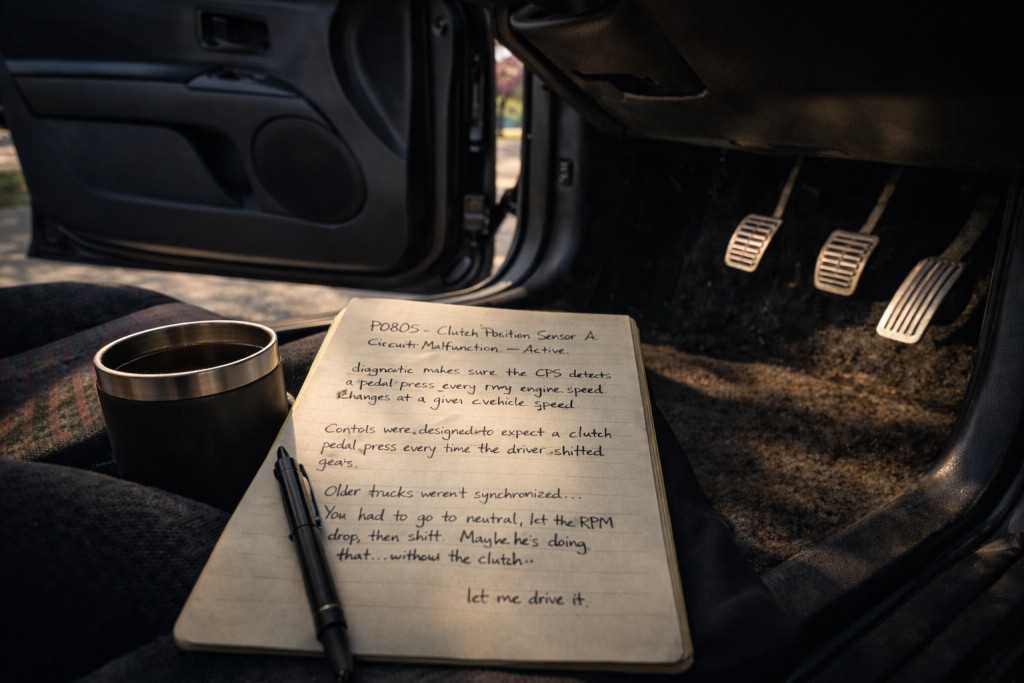
Basically, the diagnostic makes sure the clutch position sensor detects a pedal press every time the engine speed changes at a given vehicle speed. In other words, the controls were designed to expect a clutch pedal press every time the driver shifted gears.
My Italian colleagues were responsible for the engine controls for the Jeep Compass (MP is its internal code) 1.4L Turbo, but I was responsible for documentation, release to plant and vehicle integration of this engine, since the Compass was built in North America, where I was based. This meant that when there were issues at a vehicle level, I was expected to lead the investigation. In this particular case, though, I wasn’t made aware of the problem and they decided to fly someone in from Europe to investigate.
My mood was still great. The clock read 10 am, and I was outside, windows down, sunroof open, and my car enjoyable as ever. I was on my way to Roush to meet Marco.
Very friendly and approachable, Marco shook my hand and we chatted for a few minutes before walking in to the main lobby. I followed him inside and noticed his outfit was very… Italian. Business casual would have been an understatement; he looked like a real estate agent from Milano.
“My friend,” he said while addressing the guy at the front desk.
“I am looking for a vehicle, a Jeep Compass, that is setting a clutch pedal fault code. Here’s the VIN.”
The young dude at the front desk checked his computer and told us the vehicle was in the back and handed us keys to it. Before heading out to the car, though, I had a few questions.
“Hey man, a few questions maybe you can help me with,” I told the young man.
“Is this vehicle driven by the same driver all the time? Like, exclusively?” I asked.
“No, drivers have a schedule so vehicles rotate from one to another,” he responded.
“How many 1.4L manual transmission Compass do you guys have in the fleet?”
“Just this one here, but Las Vegas has around 5.”
“Has any of those 5 vehicles ever set this fault code?”
“No, only this one.”
“Is any of the drivers a very experienced truck driver? Someone that might have driven semi-trucks in the 70s or 80s maybe?”
“The driver that reported the issue might have that experience, yes, he is one of our most experienced drivers.”
That was a very interesting clue.
You see, in older heavy trucks, transmissions were not synchronized. When shifting from one gear to another, the speed of the engine changes in relation to the speed of the wheels. Say you shift from 2nd gear at 2000 engine rpm at 40 MPH, 3rd gear, at the same vehicle speed, will mean a lower engine speed, say 1500 rpm.
Without synchronizers, gears would grind when shifting: gears were spinning at 2000 rpm and all of a sudden, you want to engage them with gears spinning at 1500 rpm (slower). That won’t work.
What you do is you pull the shift lever to Neutral, leave it there until the engine goes from 2000 rpm to 1500 rpm, and then push the shift lever into 3rd gear. This can be done without using the clutch pedal.
Modern transmissions are synchronized and you don’t need to wait until the engine speed matches that of the next gear: an internal mechanism slows down the gears so their speed matches and the gear shift lever clicks into position without problems. You can, however, use a synchronized transmission just like you would an older non-synchronized one.
Man, I don’t know if it was my mood that day or what, but I was certain that this issue was really a driver shifting without using the clutch pedal. This is totally fine and expected. I do it all the time, and so do many others.
Were the controls designed by someone who had never heard of this before? Couldn’t possibly be.
I shared my theory with Marco and he immediately said that it was not possible, that such a maneuver would heavily damage the drivetrain.
“I do it all the time in my own car,” I told him, confused by his reaction.
“Maybe you should have your transmission inspected, then.” I detected sarcasm.
We jumped in the car and I connected my diagnostic tools. My laptop confirmed the fault code had been cleared and I gave it to Marco so he could monitor for codes while I drove.
About 15 minutes later, the screen of my laptop showed the magic combination of alpha-numerical characters that I was so excited to see: P0805 – Clutch Position Sensor A Circuit Malfunction – Active.
“There it is. It is a false failure most likely; we will have to send this sensor to our supplier to analyze it,” Marco said.
“What makes you think that?” I challenged him.
“I am looking at the screen and every time you shift, the counter of events (clutchless shifts) increases.”
“Yes, I’ve been shifting without touching the clutch pedal all this time,” I said, proudly.
“Haha, I would have felt and heard if that was the case!”
A quick demonstration, both up and downshifts, and he was now convinced.
Someone who had never heard of non-synchronized transmissions and how they worked had indeed designed these controls and diagnostics.
Gotta love spring, man.
Press clutch to shift gears – a story
Cold air, clear skies and sunlight. My morning workout about to start, taste of cherry…
End of Line – A story
Ah, the beauty of an assembly plant. Cars roll out by the minute, synchronized with…

PLAN – Designing an EV conversion from scratch: a SPARK walk through
Now that we’ve defined what we want this conversion to accomplish, we can start working…
Cold Trips – a story
Boring. Dark. Cold. The industrial warehouse where we sat was furnished to resemble a corporate…

Select – A SPARK walkthrough :Designing an EV conversion from scratch
Ah, EVs. Magical to some, blasphemous to others. Few topics divide the automotive world quite…

Stalls – a story
It was a chilly Pennsylvania morning. Jamie was late to work again; he forgot to…
the part about the experienced truck driver was a great clue. Practical experience can sometimes tell you things that no diagnostic tool will.
Exactly, I think practical experience is what makes diagnosing issues easier and more fun as time goes by; attention to detail pays off in the long run.