
It was a chilly Pennsylvania morning. Jamie was late to work again; he forgot to charge his iPhone, silly him. His brand-new Jeep Compass was waiting for him in the driveway. The 2.4L Tigershark engine roared to life; with the sound of an unrefined machine and the power of a leaf blower, it ungracefully propelled the vehicle, crunching leaves underneath.
“Up you go,” Jamie said, as he sunk his right foot while his left guided the clutch pedal back, very slowly, to its resting position. “No Cigar” by Millencollin was playing through the speakers, loud as it should. The HVAC was blasting cold air still; the engine coolant that should warm up the cabin wasn’t ready to do so just yet. A sudden jolt, a “jerk” if you will, surprised Jamie. “Fuck me,” he muttered under his breath. Brakes. Clutch in. Start button pressed. No luck. Numerous attempts failed and 15 minutes later, the path was clear: tow truck.
Turns out Jamie wasn’t the only one. 4 more cases like this happened on that cold November throughout the country, 2 more also in Pennsylvania.
“Make sure you document software part numbers, build dates and sales codes.” My coach was too excited about my very first problem-solving Green Belt project.
“I’ll send you the ‘IS—IS NOT’ template. Work on it on your own and we can review later,” she said.
I was used to investigations like this one. 3 years in Powertrain Controls had made me quite competent, at least that’s how I felt. “Most likely user error,” I thought to myself as I loaded the email attachment containing information on all reported cases until that moment. You have to understand, this was America in 2019; less people than ever knew how to drive a manual transmission car properly, and it wouldn’t be the first time a customer couldn’t get used to the clutch pedal feel, stalled, and blamed us. Hell, this was so common even among engineers, that I was ready to dismiss the report as a waste of time.
Those 3 cases in Pennsylvania were very interesting to me, though. Why 3 in the same week? These vehicles had been in service for a few months now. No reported dealership visits. All using the same Engine Control Module (ECM) software part number. Similarly equipped and all sold in the same area with a few weeks’ separation. Build dates were close, but not too close; they were not built on the same day or even week.
I can’t remember specific details of the non-Pennsylvania cases; all I know is that weather had also been slightly colder than usual in those places.
The IS—IS NOT exercise wasn’t conclusive. This tool helps the problem solver lay out all known facts about the event being investigated (IS) and contrast them with things that could be true, but are not (IS NOT). “The affected vehicles had manual transmissions (IS), but they could have had 9 or 6-speed automatics (IS NOT). What’s different in manuals that was potentially causing the issue?” This is the question that, when answered, would justify my salary.
By day 3 of the investigation more reported cases were piling up in my email inbox, and my supervisor and I started to realize this wasn’t only user error. Multiple meetings with various other teams yielded nothing useful. “Too many cooks in the kitchen,” I thought. But I had an advantage: my own manual-transmission 2019 Jeep Compass.
Powertrain Triage Engineer was my new official title. I was very proud of having been accepted in such a prestigious organization. Prestigious to me, at least. Most everyone else, inside and outside of the group, thought of it as “just another job.” Nah, not to me. I’ve always been a dreamer, and experience has taught me how to leverage my dreams into motivation. To me, I was now part of an elite engineering unit whose task was to fix critical issues no one else was able to. This was the SEAL Team Six of Powertrain Controls.
Armed with my childish curiosity and my newfound identity, I grabbed my CAN tool and headed out to the parking lot, where my Compass was waiting for me, anxious, excited, curious. Or maybe she was just there, an inanimate object. But that wouldn’t be as fun. Either way, the next couple of hours would be an exercise in patience, focus, and faith. Stall after stall, I had faith that I’d be able to replicate the issue: stall, crank, no start.
“Fuck yeah!” I yelled. Finally: replication. Once. No idea how, and I couldn’t do it again, so I felt frustrated. But for a hot minute there, I thought I’d hit the jackpot. This proved to be a very valuable lesson that shaped my career: do not jump to conclusions.
You see, cold engines in cold weather behave very differently than warm engines in warm weather. This detail I overlooked. At least partially. I was confident that cold weather was playing a role here, but it wasn’t as simple as that. All vehicles are extensively tested at various temperatures, from –40 °C to 55 °C. All kinds of driving maneuvers in extreme conditions and in-between expose engineers to how the systems of a vehicle behave, and corrections are made when needed. This did not look like an oversight.
Most of my testing was done, by definition, on a warm engine. Consecutive starts, stalls, restart; warmed the engine up. Not the first couple of starts, though: the engine was cold as it had been sitting, untouched, for a few hours.
On a gasoline engine, fuel is atomized to improve combustion efficiency. More fuel droplets mean more contact area between the flame and gasoline, so better combustion results. Port-injected engines, like the 2.4L Tigershark on the Jeep Compass, atomize fuel by injecting it on a closed, hot intake valve. It vaporizes just milliseconds before the valve opens, and is then sucked into the cylinder by the vacuum created by the downward motion of the piston. Cold valves do not vaporize fuel so the ECM needs to compensate by injecting considerably more fuel until the engine warms up and proper fuel atomization occurs.
“I can only replicate it in the morning or after work,” I told my coach, “so I know it’s temperature related.”
“What’s next, then?” she asked, challenging me to think harder, more methodically, like the training had taught me.
“Air, fuel, spark,” I replied. Her gaze told me she didn’t know which one to tackle first, and neither did I. But data will always hold the answers.
She is a very jealous, borderline shiesty character, this “data.” Though plural of datum, I envision “data” as a mysterious entity with whom the problem-solving dance takes place. Once you “have” her, you have got to know some moves to read her. Sometimes she takes multiple forms throughout an investigation; maybe one holds the answer, maybe one holds clues and maybe one holds nothing. It’s part of the beauty of problem-solving to learn, eventually, to identify them and seduce them through this dance.
“Air, fuel, spark” is one of those phrases you never forget. Everyone has phrases like this, but not everyone feels a strong connection to them. I do. “Air, fuel, spark” is, in essence, what a gasoline Otto-cycle engine needs to fire, and therefore, produce power. But, like most things in my life, it has a deeper meaning: method, order, control. This phrase reminds me that in most things, we can understand how to solve a problem by observing and analyzing what’s needed for something to occur and contrasting it with what we currently have. The delta between those two scenarios is our answer.
Air was easy to confirm. MAP sensor readings were available and looked normal. Vacuum was present during operation, back to barometric after a stall.
Spark was slightly trickier. Not because of difficulties acquiring data. More so because this wasn’t a binary question. Yes or no was easy; spark was being reported. Was the ECM commanding and actuating spark plugs to fire at the right time? What even is the RIGHT time? I was no specialist, so I decided to rule it out, for now.
Fuel. The fountain of life for combustion engines. This is yet another non-binary question, since confirming the presence of fuel was very easy. You could smell it. This was a key finding. In modern cars, you are not supposed to smell much fuel out of the exhaust, since excess hydrocarbons are regulated by emissions standards. Was it too much fuel injected, or improper combustion?
Stalling a manual transmission car is easy. Not this one. The little 2.4L Tigershark held on for dear life more than any other small engine I’d ever stalled. That wasn’t the case with V8s, for example, those have plenty of torque so you never feel them struggling; they either stall or they don’t, no drama. Older engines don’t have a lot of drama either; they don’t even try to stay alive.
To my keen or obsessive eye, this was strange. I was but a rookie in this industry so I couldn’t tell if such a dramatic struggle to stall a 180-ish horsepower 4-cylinder engine was normal.
Controls engineers are a weird kind, or at least here at FCA, or Fiat-Chrysler Automobiles. They design the control strategy, the “logic” of our control software. “IF the temperature of sensor 1 exceeds a certain value, then turn the fan on!” That kind of logic. Our software is a compendium of interconnected pieces of logic that constantly monitor what’s going on in the real world (inputs) so actuators can be commanded to make changes (outputs). Thus, controls engineers are extremely knowledgeable people, but mostly in their particular area; they are specialists. On the contrary, I was, and still am, a generalist; I hold just enough knowledge of many different areas that I blend, mix and use to solve bigger problems: system-level problems.
I was surprised to know that none of the controls engineers I asked knew if there was a feature in our software to prevent stalls on manual transmission cars. Automatics do have it, but no one seemed capable of confirming its existence for the manual transmission Compass.
A different breed altogether, calibration engineers tend to be more of a specialist-generalist. My calibration engineer was quick to confirm the feature does exist, and he personally calibrated it to dump more fuel in the cylinders when the engine speed falls under a certain threshold with the intent of ‘keeping it alive’. Ah! That explains the “struggle” I felt when trying to stall the engine; more fuel = more torque, at least in this case.
This detail, along with my suspicion of a cold engine being related, led me to the golden egg: replication. Now I had to feed the goose hoping to get more. As you might recall, the issue was not the stall per se, but the inability of the engine to restart after a certain stall. That “certain stall” I had just replicated. So how do I replicate it quickly? Well, my theory was that there was more fuel than needed in the cylinders, so if I had a way of giving the engine air and spark only, I’d be able to confirm my theory: if it fires, we know there was fuel in it already.
Luckily, our software had such a feature built in. Cleverly called “Clear Flood Maneuver,” triggering it would obviously attempt to clear a fuel flood in the cylinders by only allowing spark, but not fuel, into the cylinders. It fired right up and ran for a few seconds, until the gasoline inside was fully burnt. I was ecstatic!
“This is great!” my coach said. “But… what is this telling us? This does not tell me how to fix it.”
She was right. I only proved 2 things: 1) the issue does exist, and 2) it is related to excess fuel in the combustion chamber. Now what? Time to dance again, but this time I did not have a partner; I needed data of the issue happening, which was easy to get.
As one gets closer to the root cause, those dances become easier. More fun at times but less challenging; they feel more familiar since by now, the issue and the physics behind it are better understood, less of a mystery.
Data clearly showed injectors dumping gasoline due to “stall protection,” causing the feeling of the engine struggling to continue running; no surprise there. Upon my first restart attempt, however, something surprising happened: even more fuel was dumped during cranking. Confused at first, I went back to talking to myself. “There’s already a significant amount of fuel in there; why are we adding more?” It made no sense. Remember how cold engines behave? Valves are cold. Gasoline will not be properly atomized. We need more fuel to ensure combustion.
Well, turns out that I was right. Trying the same “stall protection” maneuver on a fully warm engine showed that roughly the same amount of “excess” fuel was being injected in an attempt to prevent a stall when compared to the cold engine data. Since I was able to actually cause a stall, we know that most of that fuel remains inside, unburnt. The difference was that I could very easily restart the engine normally the next time I pressed the START button; no Clear Flood Maneuver needed.
There are moments in life that, in retrospect, or to an external observer, seem mundane, boring. Some of these moments, to those who experience them, can feel enormous, life-changing.
Novels are written around moments like this, history has been shaped by them, the elderly won’t stop talking about them to the young ones, no matter how bored everyone looks when forced to listen to the same boring, seemingly innocent and unimportant stories.
Those data, or “that data,” my final dancing partner of this investigation, froze this moment in my mind. Unimportant as it may look to the uninvolved, looking at colored lines in my screen confirmed that all my sacrifice to get to where I was, finishing school, moving to another country, pushing through all the obstacles, had been worth it: I was really following my passion, not just a job.
“On a fully warm engine, the start fuel multiplier is 1. On a cold engine, this multiplier is 1.3, 30% more fuel injected into an already flooded cylinder makes spark ignition impossible,” I concluded. My results, presented to senior managers and calibration engineers, was convincing and applauded by many.
One of the calibration engineers, though, an old, experienced and particularly grumpy member of the crowd was not happy with my conclusions. It meant more work for him.
“Well, welcome to calibration, I guess,” he said in a very ironic, borderline mocking tone.
To me, that was a compliment. I was finally entering the big leagues.
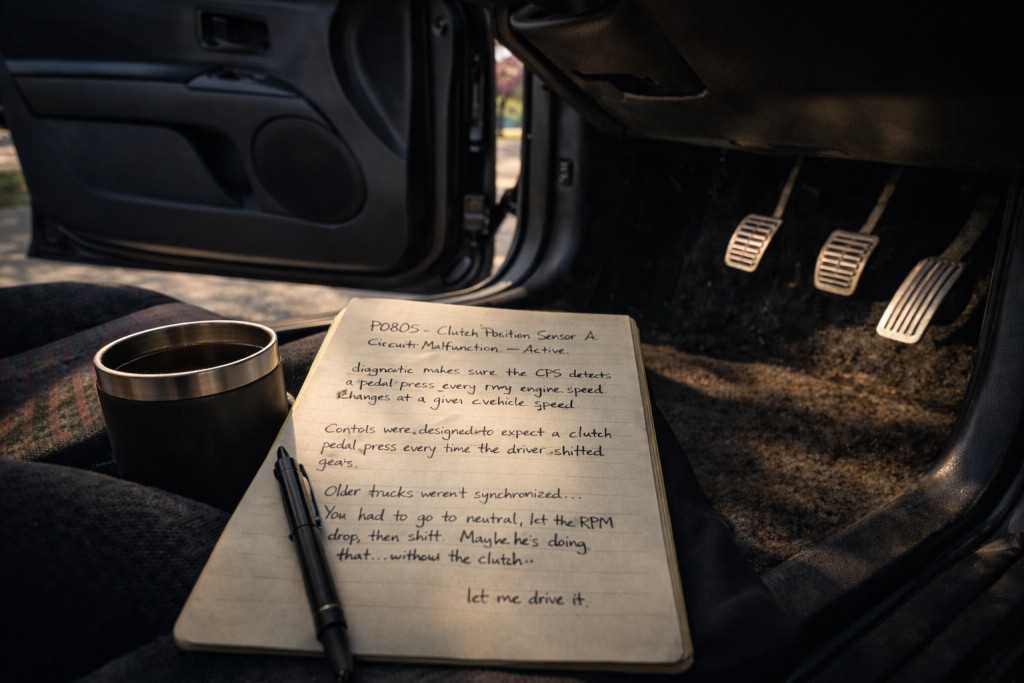
Press clutch to shift gears – a story
Cold air, clear skies and sunlight. My morning workout about to start, taste of cherry…
End of Line – A story
Ah, the beauty of an assembly plant. Cars roll out by the minute, synchronized with…

PLAN – Designing an EV conversion from scratch: a SPARK walk through
Now that we’ve defined what we want this conversion to accomplish, we can start working…
Cold Trips – a story
Boring. Dark. Cold. The industrial warehouse where we sat was furnished to resemble a corporate…

Select – A SPARK walkthrough :Designing an EV conversion from scratch
Ah, EVs. Magical to some, blasphemous to others. Few topics divide the automotive world quite…

Stalls – a story
It was a chilly Pennsylvania morning. Jamie was late to work again; he forgot to…